Reports
From Secure Links to Entangled Systems: A Roadmap for Global Quantum Infrastructure
Technology Readiness Snapshot
Programme | Current TRL | TRL @ 3 mo | TRL @ 9 mo | TRL @ 12 mo | Key Performance Indicators (KPIs) |
|---|---|---|---|---|---|
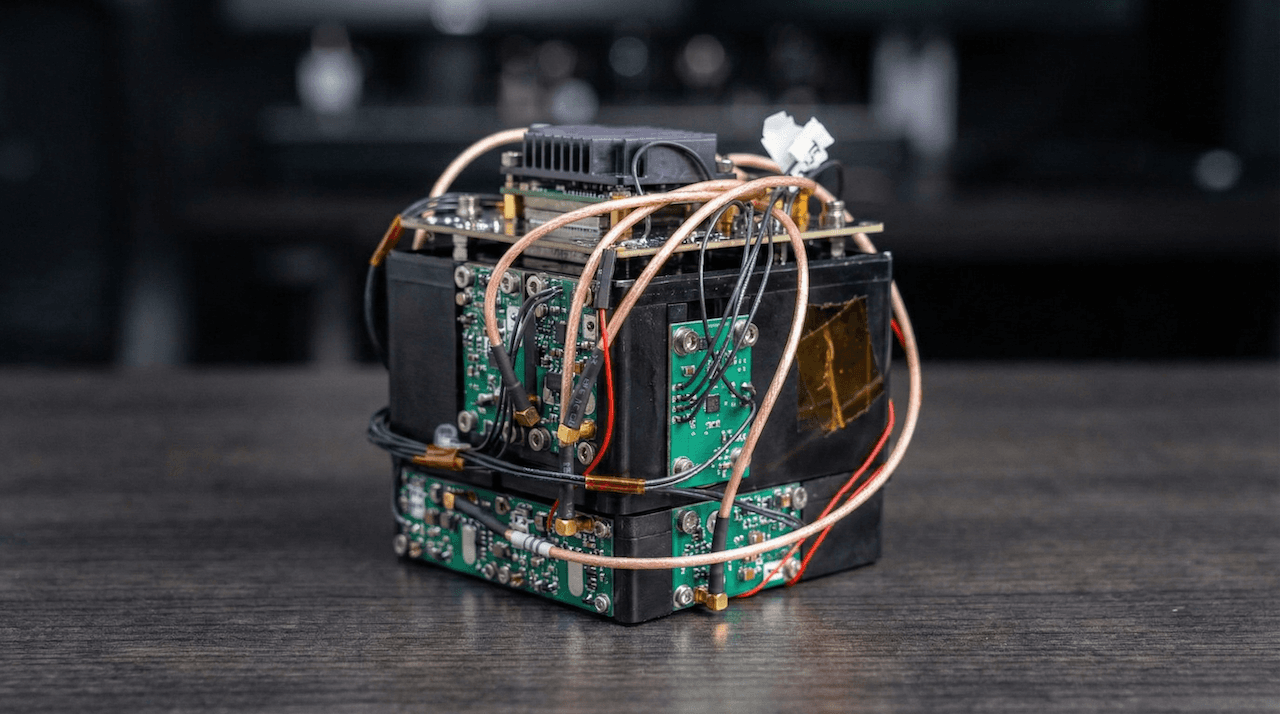
QubitCore CubeSat Payload (Space QKD / Entanglement-ready) | 5 (validated in relevant environment on ground; payload complete) | 6 – environmental + functional qualification | 6–7 – on-orbit verification (QKD) | 7 – first orbital entanglement tests | • Key rates in line with CubeSat class |
Aerial Quantum Relays (Drones/UAV) | 3 (experimental proof of concept) | 4 – stabilized free-space module | 5–6 – extended-range flight trials | 6 – multi-node demonstration with partner | • Entanglement fidelity in outdoor conditions |
Terrestrial Entanglement Sources (Fiber & Free-Space) | 7 (stable bench-tested, demonstration in operational environment) | 7-8 – robust field package | 8 – integration with telecom control layers | 9 – full commercial product | • Pairs production rate |
Quantum Memories (Atomic Vapour) | 3 (lab prototypes) | 4 – improved stability + remote heralding compatibility | 4–5 – fieldable prototype module | 5 – first entanglement-swapping demonstration | • Storage time |
NV-Center Magnetometry | 2 (Technology concept formulated) | 3 – (experimental sensors in lab environment) | 4 – advanced fieldable module | 5 – initial industrial pilot | • Sensitivity |
Executive summary
The world is approaching a technological inflection point: classical communication infrastructures can no longer guarantee long-term security, precision timing, or scalable integration with emerging quantum computers and sensors. Encryption schemes that underpin global commerce and national security face obsolescence in the quantum era; classical synchronization can no longer support the accuracy of next-generation clocks; and the absence of quantum interconnects is becoming the bottleneck for distributed quantum computing and large-scale sensing. Without coordinated investment, nations and industries risk fragmentation, dependence on external providers, and the loss of technological sovereignty.
Quantum connectivity is the solution. By distributing entanglement across fiber, free-space, and satellite channels, quantum networks provide security rooted in physics, enable sub-femtosecond time synchronization, and connect quantum processors and sensors into powerful cooperative systems. This emerging infrastructure will underpin secure communication, finance, navigation, scientific measurement, and distributed quantum computation. But building it requires moving beyond isolated demonstrations toward deployable, interoperable, and secure systems.
The moment to act is now. Quantum communication technologies have left the laboratory: national testbeds exist across Europe, North America, and Asia; early QKD services are operational; and space-based missions are proving global-scale feasibility. At the same time, industrial supply chains remain immature, and standards are only beginning to consolidate. Countries and organizations that invest today will define global interoperability, security norms, and the market architecture for the quantum internet. Those who delay will rely on the infrastructures built by others.
Qubitrium offers the technology stack needed to accelerate this transition. The company develops miniaturized, space-qualified quantum communication payloads, aerial free-space systems, fiber-based entanglement sources, atomic-vapour quantum memories, and secure control architectures. These form the foundation for hybrid quantum networks that operate consistently across terrestrial, airborne, and orbital environments. Qubitrium provides:
Quantum communication hardware: space-ready entanglement/QKD payloads, free-space terminals, rugged fiber units.
Quantum memories and early repeater modules: atomic-vapour ensembles designed for entanglement storage, swapping, and synchronization.
Aerial quantum platforms: drone- and HAPS-based relay systems for rapid, reconfigurable coverage.
Secure control & orchestration software: frameworks aligned with emerging standards for managing entanglement and QKD flows.
Integration services: system design, deployment support, and interoperability testing with telecom and space operators.
Together, these products and services enable the first generation of deployable quantum networks that can evolve toward full-scale quantum internet capabilities.
Near-term milestones (0–3 years)
QubitCore CubeSat launch and operations
Demonstrating space-based QKD and the first steps toward orbital entanglement distribution using a fully miniaturized payload.Aerial quantum relay deployments with service providers
Scaling drone- and UAV-based free-space links into operational pilots for urban connectivity, critical infrastructure, and emergency use.Quantum memory and early repeater integration
Demonstrating multi-hop entanglement paths in terrestrial networks through buffering, swapping, and synchronization enabled by atom-vapour memories.
What we seek: partners, pilots, and funding
To move from demonstrations to infrastructure, Qubitrium is seeking:
● Telecom and cloud partners to host terrestrial pilots, integrate quantum control layers, and run early entanglement-based services.
● Space operators and agencies to co-develop satellite missions, ground-segment integration, and space–ground interoperability.
● Industrial and government pilot customers for secure communication, precision timing, and networked sensing use cases.
● Co-investment and funding partners to accelerate industrialization, supply-chain scaling, and certification—through matching funds, milestone-based support, and long-term procurement commitments.
Quantum networks are no longer a distant aspiration—they are strategic infrastructure already under construction. Qubitrium’s roadmap provides a practical, deployable pathway from prototype systems to interconnected, global quantum services. With the right partners and coordinated investment, we can build the foundations of the quantum internet this decade.
From Secure Links to Entangled
Thirty years ago, the concept of the qubit was mostly a theoretical curiosity — a fragile superposition in a lab experiment. Since then, quantum science has evolved into one of the most transformative technological races of the 21st century. What began with single photons and isolated ions has grown into a global effort to build fault-tolerant quantum computers, scalable quantum communication networks, and quantum-enhanced sensors that exceed the limits of classical measurement. Today, this evolution has reached a phase where quantum technologies are no longer speculative research projects, but strategic infrastructures already under construction.
Quantum communication was the first of these technologies to escape the laboratory. Its most mature application, Quantum Key Distribution (QKD), provides a method to exchange cryptographic keys whose security is guaranteed by the laws of physics rather than computational assumptions. QKD emerged as a timely response to a looming threat: the advent of quantum computers capable of breaking traditional cryptographic schemes such as RSA and elliptic curve cryptography. Yet, QKD represents only the first visible layer of a much larger transformation. The physical infrastructure deployed for QKD, such as fibers, satellites, and free-space links, forms the early scaffolding of the quantum internet, a global network where entanglement is distributed between distant nodes to enable not only secure communication, but also distributed quantum computing, precision sensing, and advanced timing services.
This shift from point-to-point security toward entanglement-based connectivity marks a profound evolution. A QKD link secures a single channel; a quantum network will secure and empower entire systems. It will enable geographically separated quantum computers to work as one machine, synchronize optical clocks to a precision unattainable by classical means, and link quantum sensors into cooperative arrays that detect gravitational, electromagnetic, or environmental changes with unprecedented sensitivity.
Around the world, this vision is already materializing. In Europe, the European Quantum Communication Infrastructure (EuroQCI) program, coordinated under the EU Quantum Flagship and the Digital Europe Programme, is building a continent-wide backbone that integrates terrestrial fiber networks with satellite segments to achieve sovereign, end-to-end quantum security. Complementary programs, such as EuroHPC JU, are developing quantum–classical high-performance computing ecosystems, highlighting the need to interconnect future quantum processors through secure, low-latency quantum networks. In parallel, China has made extraordinary progress: its Micius and subsequent quantum satellites have demonstrated both QKD and entanglement distribution over thousands of kilometers, linking multiple ground stations and establishing the first operational quantum communication backbone. Europe is responding with missions such as Eagle-1, a partnership between ESA and the European Commission, which will demonstrate space-based QKD and pave the way for a new generation of secure global quantum links. The United States, Japan, and Canada are following with national quantum network testbeds that connect laboratories, data centers, and early commercial users.
One reason for this international momentum is that quantum networks cannot rely solely on fiber. While optical fibers provide stable channels over metropolitan and regional distances, they are limited by attenuation and the limitations of amplifying quantum signals. Quantum repeaters will eventually overcome these constraints, but in the near term, space-based communication will be essential to connect continental-scale networks. Satellites in low Earth orbit can distribute entanglement and cryptographic keys over thousands of kilometers, bridging national networks and providing truly global coverage. Free-space links, both ground-to-ground and via aerial platforms such as drones and high-altitude relays, will complement fiber, forming hybrid architectures where paths are dynamically optimized according to distance, weather, and security requirements. The quantum internet, therefore, will be a layered and heterogeneous infrastructure, seamlessly combining fiber, free-space, and satellite channels.
The importance of this hybrid approach extends beyond communication. In parallel, quantum sensing, metrology, and imaging are entering a stage of rapid practical deployment. At first, these technologies may appear as isolated instruments — quantum upgrades to existing sensors that offer improved precision or dynamic range. However, their true potential will emerge when they are interconnected through quantum networks. Entangled interferometers, clock networks, and distributed quantum sensors will operate cooperatively, achieving sensitivities that scale not linearly but exponentially with the number of linked devices. A single quantum sensor can detect; a quantum sensor network can perceive.
This is especially evident in timekeeping. Modern optical lattice clocks already achieve fractional frequency uncertainties below one part in 10¹⁸, surpassing the precision of any existing global time standard. Yet their accuracy is now so high that classical synchronization protocols, based on radio or optical transfer using classical light, are insufficient. Maintaining coherence among such clocks will require entanglement-assisted synchronization, where quantum networks distribute shared quantum states to align time references across vast distances. The same entangled infrastructure will underpin secure synchronization for navigation systems, financial networks, and scientific observatories, establishing a new global timing fabric.
As these threads converge, it becomes clear that quantum computing, communication, and sensing are not isolated disciplines but components of a single technological ecosystem. Quantum computers will depend on quantum networks to exchange entangled states and scale beyond local architectures. Quantum sensors will benefit from being entangled across quantum networks and quantum data analysis performed directly by quantum processors. Quantum networks themselves will provide the backbone for these interactions — distributing, storing, and orchestrating entanglement as a programmable resource. This interplay will define the next generation of critical infrastructure, intertwining physical security, computational capability, and scientific discovery in one coherent system.
For Qubitrium, this moment defines both an opportunity and a responsibility. The infrastructures being built today, from metropolitan fiber rings to quantum satellites, will determine not only who controls the flow of secure information, but who sets the standards for global quantum interoperability. Investing now means shaping the architecture of a future where entanglement is a service, quantum data flows alongside classical data, and the boundary between computation, communication, and sensing begins to dissolve. The race is no longer solely for quantum computers, but for the quantum networks that will connect and empower them.
We stand, therefore, at the beginning of a new connectivity era, one in which the fundamental principles of quantum mechanics become the foundation for security, precision, and intelligence across the planet. The time to act is now.
From Demonstrations to Infrastructure: Near-, Mid-, and Long-Term Horizons
Quantum connectivity is transitioning from isolated demonstrations to a coordinated infrastructure. The coming decade will define how these technologies move from research platforms into operational networks that secure communication, enable precision sensing, and interconnect emerging quantum processors. Qubitrium’s activities sit precisely at this inflection point — translating laboratory achievements into deployable systems. The current portfolio of space, aerial, and terrestrial demonstrators provides the foundation for an ambitious roadmap that extends across three horizons: near-term implementation, mid-term scaling and integration, and long-term convergence into a global quantum infrastructure.
Near-Term Horizon (0–3 years): Deploy, qualify, and secure
In the immediate future, the focus remains on transforming prototypes into operationally robust systems. Qubitrium’s forthcoming CubeSat demonstrator, called QubitCore, carrying a space-qualified quantum communication payload, marks a pivotal milestone. The platform has been engineered with strict constraints on size, weight, and power (SWaP), proving that miniaturized and ruggedized quantum systems can perform in the harsh environment of space. The mission will validate both quantum key distribution (QKD) and the first steps toward entanglement distribution from orbit, a crucial capability for the next phase of global quantum connectivity.
On Earth, these same compact payloads extend their utility beyond orbit. Qubitrium has already demonstrated drone-based entanglement distribution using the entanglement-based (BBM92) protocol, where the drone acted as a mobile entangled-photon source. This demonstration underlined the potential of aerial quantum relays: rapidly deployable, reconfigurable nodes that can bridge urban environments or restore secure communication in emergencies. The same hardware enables free-space quantum time transfer, a building block for entanglement-assisted synchronization of clocks and sensors.
Recognizing that quantum networks will operate as critical infrastructures, Qubitrium is also investing heavily in quantum system security. Demonstrations of side-channel attacks and their countermeasures are being integrated into the design cycle to ensure that every layer of the network—from photon source to key generation—is hardened against realistic adversarial models. These efforts form the basis of a “security-by-design” philosophy that will remain central as Qubitrium systems transition from prototypes to services.
In parallel, work on quantum memories and elementary repeater functions is progressing. Qubitrium’s memory line is based on atomic-vapour ensembles, engineered to map and store photonic qubits as collective excitations with long coherence times and to release them on demand with high retrieval efficiency. These memories enable entanglement swapping by storing the quantum states of photons until heralding signals indicate that remote entangled pairs are ready, thereby extending point-to-point links into multi-hop quantum paths. As the control stack matures, these quantum memories will evolve into practical “quantum modems”—interfaces that connect photonic channels of the quantum network with stationary qubits in quantum processors. Such devices will enable synchronization, state transfer, and entanglement purification routines essential for linking quantum computers across metropolitan and, ultimately, continental scales.
Across these developments, Qubitrium is working closely with leading service providers to ensure that each technology can transition smoothly from laboratory demonstrations to operational field deployments.
Separately, Qubitrium’s NV-center program focuses on quantum sensing, specifically on magnetometry applications. The work uses nitrogen–vacancy defects in diamond to measure magnetic fields with very high sensitivity and spatial resolution under practical, room-temperature conditions. Current activities concentrate on developing compact, stable sensor heads and refining optical excitation and readout methods to improve signal quality and robustness. At this stage, the effort is directed toward stand-alone NV-based magnetometers, providing a reliable platform for precision field measurements, calibration, and laboratory demonstrations.
In short, the near-term horizon is about qualifying the technology, hardening security, and deploying the first operational links—from orbit with the CubeSat demonstrator, to aerial free-space trials using miniaturized payloads, to ground networks that exercise trapped-atom memories and secure control. These deployments create the substrate on which repeater prototypes, networked sensing pilots, and early quantum-modem integrations can be layered in the next phase.
Primary customers:
National laboratories & research networks (first to adopt entanglement testbeds, quantum memories, CubeSat links)
Telecom operators & data-centre operators (integration of early QKD/FSO links, urban pilots, aerial relays)
Justification: Early deployments focus on validation, field trials, and co-development with partners who already run critical communication infrastructure.
Mid-Term Horizon (3–7 years): Integrate, network, and extend
As the basic elements mature, the next horizon focuses on integration and networking. The challenge shifts from proving feasibility to achieving scalable interoperability. Qubitrium’s miniaturized payloads will evolve from single-link devices into components of multi-node quantum constellations, capable of distributing entanglement between multiple ground stations or even between satellites. Entanglement-swapping techniques will be introduced to create longer paths and higher rates, gradually extending the effective range of secure quantum links.
On Earth, hybrid fiber–free-space architectures will become increasingly important. Compact entangled-photon sources derived from the CubeSat line will be deployed on rooftops, towers, and mobile platforms to build reconfigurable terrestrial quantum networks. Such systems will be ideal for urban testbeds, temporary mission areas, or critical infrastructure nodes requiring redundancy beyond fiber optics. Integration with classical control layers will allow Qubitrium networks to interoperate with existing SDN (software-defined networking) frameworks, paving the way toward quantum network orchestration where entanglement becomes an allocatable resource.
Security research will continue to advance toward measurement-device-independent (MDI) and device-independent (DI) architectures, reducing trust assumptions and eliminating entire classes of attacks. The company’s experience in side-channel mitigation will evolve into a formal quantum assurance framework, aligning with emerging standards from Europe, ISO, and the ITU.
At the same time, quantum memory development will enter practical deployment, enabling small-scale repeater chains. These will not only increase range but also introduce buffering and synchronization capabilities critical for connecting quantum computers. Prototype quantum modems will allow local quantum processors to interface with the broader network, facilitating early experiments in distributed quantum computation and secure cloud access to quantum hardware.
Finally, Qubitrium’s development of NV-based sensing technologies will mature into compact and deployable magnetometry devices designed for reliable operation outside the laboratory. The immediate effort remains focused on improving stability, packaging, and readout performance for stand-alone use. While the present roadmap does not yet include networking or coordinated multi-sensor operation, these developments lay the technical foundation for potential future integration into broader quantum-enhanced sensing architectures as those capabilities and demand mature.
New primary customers:
Ministries of Defence / national security agencies (secure backbone, long-range links, early repeaters, hybrid networks)
Grid operators & financial exchanges (precision timing via quantum time transfer, ultra-secure control networks)
Justification: These sectors have high-value timing, security, and resilience requirements—exactly where mid-scale integration becomes attractive.
Long-Term Horizon (7+ years): Converge and orchestrate
The long-term vision is the emergence of a truly integrated quantum infrastructure, where communication, computation, and sensing merge into a unified entanglement fabric. Qubitrium’s technology roadmap aims to provide infrastructure for satellite constellations that distribute entanglement globally and seamlessly interoperates with terrestrial and aerial segments. These networks will form the backbone of quantum internet services, where applications request entanglement, time transfer, or secure communication through standardized APIs rather than bespoke links.
At this stage, quantum repeaters will be operational and connected to quantum memories at the network edge, enabling stable, long-distance entanglement distribution at high fidelity. This will make it possible to connect quantum computers in different data centers, establishing the first practical instances of distributed fault-tolerant quantum computing. The same infrastructure will synchronize quantum clocks worldwide, supporting next-generation navigation, geodesy, and scientific instruments that demand time precision far beyond classical limits.
The integration of quantum sensing arrays with these networks will create a new kind of planetary observatory: a mesh of entangled sensors capable of detecting gravitational shifts, magnetic field changes, and atmospheric or seismic variations in real time. Data from these sensors could be analyzed directly by quantum processors connected through the same network, extracting patterns inaccessible to classical analytics.
In parallel, quantum networks will be fully embedded within classical infrastructure. Fiber backbones, ground stations, and data centers will co-host both quantum and classical channels, while control planes dynamically allocate resources between them. Space-based systems will extend secure and scientific connectivity to remote regions, oceans, and intercontinental routes. The resulting ecosystem will operate as a hybrid quantum–classical internet, where entanglement distribution is as fundamental as bandwidth allocation is today.
For Qubitrium, this horizon represents not just technical achievement but strategic positioning: to be a provider of end-to-end quantum connectivity infrastructure, offering QKD, entanglement distribution, networked sensing, and quantum clock synchronization as part of a unified platform. By moving deliberately through these three horizons — demonstration, integration, and convergence — Qubitrium can help shape how quantum networking evolves from a scientific frontier into the next generation of global infrastructure.
New primary customers:
Satellite primes & space-system integrators (quantum payload integration into constellations, global entanglement distribution)
Cloud providers & quantum-computing service operators (distributed QC, quantum modems, entanglement-as-a-service)
Justification: Once networks mature, large-scale commercial platforms and global operators become the dominant users.
Deployment Outlook: Building a Hybrid Quantum Connectivity Fabric
The path toward a functional quantum network will not rely on a single communication channel or technology. Instead, it will emerge as a hybrid architecture, where fiber, free-space, aerial, and satellite links complement one another to form a seamless connectivity fabric. Each medium contributes a distinct balance of range, stability, and flexibility, and together they define the global geometry of quantum communication. Qubitrium’s deployment strategy builds on this diversity, using its existing demonstrators as building blocks for a scalable, interconnected system.
Fiber networks will remain the backbone of terrestrial quantum connectivity. They provide stable, low-loss environments ideally suited for metropolitan and regional links, where high key rates and minimal environmental interference are paramount. Fiber channels also serve as the primary testbeds for integrating atom-vapour quantum memories and early repeater prototypes, establishing the first steps toward long-distance entanglement distribution. Over time, fiber networks will evolve into trusted terrestrial segments such as the one of the European Quantum Communication Infrastructure, hosting both classical and quantum channels under unified management.
Where fiber cannot reach, free-space optical (FSO) links provide flexibility and reach. Their ability to bridge short gaps—across rivers, valleys, or urban canyons—makes them indispensable for connecting isolated nodes. Qubitrium’s free-space experiments, including drone-based entangled-photon distribution and quantum time-transfer tests, have shown that compact payloads can deliver high-quality quantum states through the atmosphere. These systems demonstrate the advantages of mobility and rapid deployment, key to emergency communications, temporary missions, and research testbeds. As adaptive optics and beam-tracking mature, free-space terminals will become a reliable extension of the fiber backbone.
Aerial platforms, such as drones, high-altitude UAVs, and HAPS (High-Altitude Platform Systems), occupy a special niche between ground and orbit. They provide dynamic, rapidly deployable relays that can reconfigure the network topology within minutes and extend coverage far beyond line-of-sight terrestrial links. Qubitrium’s airborne entanglement demonstrations have already validated the concept of mobile quantum nodes, proving that compact, stabilized payloads can maintain quantum correlations even under flight dynamics. Building on this foundation, future generations of aerial systems will include long-endurance UAVs and stratospheric HAPS platforms, enabling wide-area quantum connectivity. These systems will focus on extended flight durations, autonomous beam alignment, and seamless integration with both terrestrial networks and satellite segments, transforming aerial assets into agile quantum relays that enhance coverage, resilience, and network adaptability.
Above all, satellites will play a central role from the very beginning. Because optical loss in fiber grows exponentially with distance, intercontinental quantum links require space-based channels. Qubitrium’s upcoming CubeSat mission, featuring a space-qualified QKD payload, represents the first step toward this capability. The same miniaturized, ruggedized technology will evolve into a full entanglement-distribution platform, enabling downlinks that connect national or regional networks. Future iterations could form small constellations of cooperating satellites. Space-based nodes will anchor the architecture, providing global reach and redundancy while enabling scientific and commercial services that no purely terrestrial network could achieve.
Together, these layers—fiber for density, free-space for flexibility, drones for adaptability, and satellites for reach—form the blueprint of the Qubitrium hybrid quantum network approach. The company’s roadmap envisions a continuum of connectivity, where entanglement can be distributed across any combination of links depending on mission requirements. By designing hardware and control protocols that operate consistently across all these media, Qubitrium is laying the foundations for a scalable and interoperable quantum communication fabric that can grow organically into the full quantum internet of the future.
Policy & investment guidance
Quantum networks are moving rapidly from laboratory experiments to pre-operational infrastructures. The countries and organizations that act early will shape the global standards, interoperability frameworks, and market leadership of the quantum internet. To ensure strategic autonomy, resilience, and technological competitiveness, policy and investment efforts must now shift from individual demonstrations toward coordinated, large-scale deployment. Qubitrium’s roadmap — spanning CubeSats, aerial systems, free-space terminals, and terrestrial links — exemplifies how targeted investment can turn research capability into infrastructure readiness.
1. Invest in hybrid infrastructure and national integration
Quantum connectivity should be recognized as a critical digital infrastructure, much like fiber broadband or satellite navigation. Policymakers should prioritize programs that integrate quantum communication technologies into existing telecommunication, defense, and scientific networks, ensuring compatibility and shared operation with classical channels. Investment in hybrid ground–space architectures — combining fiber, free-space, drones, and satellites — will maximize coverage and resilience while avoiding technological lock-in.
Support for national testbeds and cross-border interoperability pilots will ensure that early deployments evolve toward architectures compatible with major international frameworks. While initiatives such as EuroQCI and Eagle-1 are primarily European, they provide valuable reference models for how large-scale, secure quantum infrastructures can be organized. Qubitrium’s roadmap follows a similar vision—developing a sovereign yet interoperable quantum communication infrastructure that can integrate with global systems and complement regional programs. Such alignment of standards and technical approaches will allow non-EU partners to build compatible networks and participate in the emerging global quantum connectivity ecosystem.
2. Support industrialization and supply-chain maturity
Current quantum network components still depend on laboratory-grade assemblies and niche suppliers. To move toward operational scale, public and private investment must focus on industrialization and miniaturization: stable sources, rugged detectors, cryogen-free memories, and compact optical assemblies. Because early-stage costs and supply-chain gaps remain high, targeted subsidies and coordinated funding schemes, such as matching funds, milestone-based grants, and procurement guarantees, will be essential to derisk industrial scaling.Programs that promote certification, manufacturing readiness levels, and supply-chain diversification will be crucial. Qubitrium’s development of space-qualified and miniaturized payloads demonstrates how targeted investment can yield dual-use technologies applicable both in orbit and on the ground.
3. Establish security and trust frameworks
As quantum networks will handle sensitive and strategic data, security-by-design policies must be embedded from the outset. Regulators should promote certifiable security standards for quantum key distribution, side-channel resilience, and physical protection of trusted nodes. Collaboration between technology developers, cybersecurity agencies, and standardization bodies (ETSI, ITU, ISO, CEN/CENELEC) should converge on auditable security benchmarks. In parallel, coordinated research into measurement-device-independent (MDI) and device-independent (DI) architectures will gradually reduce the need for trusted nodes, improving systemic trust and reducing certification overhead in the long term.
4. Encourage collaboration across sectors
Quantum networking sits at the intersection of space, telecommunications, and computing. Policymakers should incentivize partnerships that bridge these traditionally separate domains — uniting satellite operators, telecom carriers, research institutes, and cloud-computing providers. Joint funding calls, public-private partnerships (PPPs), and shared test infrastructure will accelerate both innovation and standardization.
The emerging quantum market benefits from open collaboration: shared ground stations, common control software, and data standards lower entry barriers and build confidence for private investors. Qubitrium’s experience in cross-domain integration — combining satellite payload design, aerial experiments, and fiber-based repeaters — shows how multi-sector cooperation can drive innovation efficiently.
5. Create long-term financing and procurement instruments
Unlike short-term research projects, quantum networks require sustained continuity over decades. Governments and funding agencies should establish long-term procurement mechanisms to guarantee stable demand, such as framework contracts for secure quantum communication services or anchor tenancy in space-based links. Blended financing models that combine public R&D support, venture capital, and infrastructure funds can de-risk early industrialization phases.
Incentives for dual-use technologies — with applications in both civilian and governmental domains — will help attract private capital. Clear return-on-investment narratives, such as reduced data-breach exposure, enhanced timing accuracy, and sovereign secure communications, are key to unlocking sustained funding.
6. Align with Global and Regional Quantum Roadmaps
To ensure interoperability and maximize the impact of national investments, policies should be guided by the broader global quantum roadmap, aligning in standards, architecture, and interoperability rather than in formal membership. European programs such as the EuroHPC Joint Undertaking, EuroQCI, Eagle-1, and ESA’s Quantum Missionsprovide strong reference models for integrated ground–space quantum infrastructures. Similar developments are underway in North America and Asia, together forming a rapidly maturing international ecosystem.
Qubitrium’s strategy aims to develop an infrastructure compatible with these leading frameworks, enabling cooperation, data exchange, and interoperability across borders. Establishing technical and policy alignment at the global level—without dependency on any single regional initiative—will be key to avoiding fragmentation and ensuring worldwide compatibility of quantum communication protocols.
A Call to Action
The coming decade will determine the architecture of secure global communication for the next century. Quantum networks are no longer distant visions but practical engineering programs requiring sustained investment and coordination. The decisions taken today — on infrastructure, security, and standards — will define who controls the backbone of quantum connectivity.
Qubitrium stands ready to contribute its technology, testbeds, and expertise to this collective effort. By aligning policy, funding, and industry momentum, governments and partners can accelerate the transition from research to reality, establishing quantum communication as a strategic capability and commercial service that secures both data and sovereignty in the quantum era.
Conclusion: Toward an Entangled Infrastructure
Quantum technologies have reached the point where they are no longer a scientific promise but a technological necessity. Across the world, governments and industries are laying the foundations of quantum communication, computation, and sensing. Yet the real transformation will come not from any single breakthrough, but from their convergence into a connected ecosystem — one where quantum devices, memories, sensors, and processors interact through a common network fabric.
Qubitrium’s vision is to make this convergence practical. By developing miniaturized, space-qualified quantum payloads, aerial and terrestrial demonstrators, and secure, scalable control architectures, the company is translating fundamental science into deployable systems. Its CubeSat missions, drone-based experiments, and memory development all contribute to the same objective: creating a flexible and interoperable quantum connectivity layer that complements classical communication and extends it into new physical and functional domains.
This vision is not confined to any single region. The quantum internet will ultimately be a global endeavor, linking sovereign infrastructures into a coherent, standards-based network of trust and capability. Each participating nation and organization will bring unique contributions: scientific, industrial, and geographic. Qubitrium’s approach, which builds on its international presence, embodies this principle of distributed innovation: developing local expertise while ensuring compatibility with international frameworks.
The coming decade will decide whether quantum connectivity remains a collection of isolated experiments or evolves into a foundational layer of the world’s digital infrastructure. Achieving the latter requires sustained cooperation between research, industry, and policy; between local initiatives and global standards; and between classical and quantum technologies.
Qubitrium’s roadmap demonstrates that this path is already open. By continuing to invest, collaborate, and innovate, we can turn entanglement from a laboratory phenomenon into a resource that secures communications, synchronizes clocks, links quantum computers, and senses the world with unprecedented precision.
The quantum network era has begun — not as a distant vision, but as infrastructure under construction.
RESOURCES